Cabarete Beach Condos — and How the East Coast Compares
Cabarete is on the Dominican Republic's north coast, in Puerto Plata province. River Island is on the east coast, inside the gated Atlántida community at Punta Cana, and the two sit at opposite ends of the island. So this page is not a Cabarete listing and cannot pretend to be one. It is written for the buyer comparing coasts rather than buildings: what the Cabarete beach-condo market actually runs on, and how the Punta Cana and Bávaro side differs on flight access, tourism volume, when the rental calendar fills, and what the sea does in winter.
The honest starting point: this is not a Cabarete property
River Island sits in Atlántida, on the east coast behind Playa Bávaro. Cabarete is a north-coast town roughly five hours away by road across the island, according to route planners such as Rome2Rio. Nothing on this page can put you on Cabarete Bay, and it would be dishonest to imply otherwise.
What a page like this can usefully do is answer the question underneath the search. Most people typing “cabarete beach condos” are not loyal to a town — they are weighing a Caribbean purchase and have landed on the destination the watersports press writes about. Those are two genuinely different products on one island, and the differences that matter to an owner are not the finishes. They are how easily people fly in, what fills the weeks, and what the shoreline does between November and March. That is what the rest of this page sets out, coast against coast.
What “beach condo” means on each coast
In Cabarete the beach is the activity. The bay is a working watersports arena: the wind builds through the late morning, peaks through the afternoon, and the schools, rental lockers and board storage along the sand exist because of it. Kite Beach is a mile or so west of town and Playa Encuentro, about three miles west, is a reef-break surf beach. A condo there is bought to be near that, and its value to a guest is measured in wind and swell.
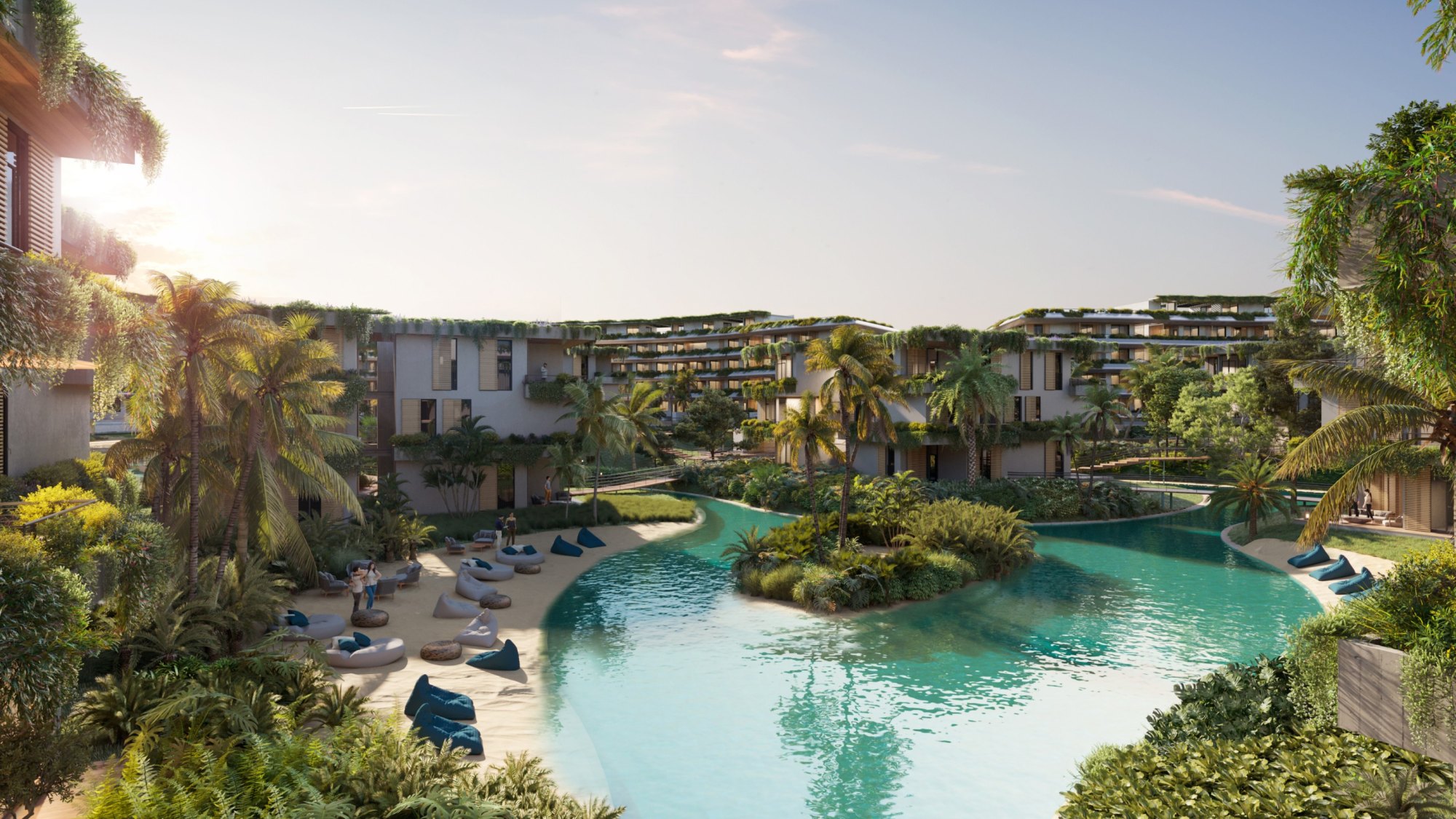
The Bávaro shoreline is a calmer proposition — pale sand, a shallow shelf and an offshore reef, with an afternoon breeze rather than a wind season. River Island is not beachfront either, and we would rather say so than blur it: the development is inland of the sand inside Atlántida, a five-minute drive from Playa Bávaro, where owners have beach-club access. Its own water is a designed one — 16 interconnected pools threaded by a river pool. If stepping off your terrace onto a kite beach is the point of the purchase, that is a north-coast product, not this one.
The two areas side by side, on what an owner actually feels
Flight access is the dimension buyers underestimate, and it is the one that quietly sets everything else. Punta Cana International is a ten-minute drive from our gate, and the Banco Central's tourism-flow report for 2025 counted 5,275,492 foreign arrivals entering the country through it — roughly seven of every ten people who arrived by air. Cabarete is served by Gregorio Luperón (POP) at Puerto Plata, about half an hour away; Wikipedia's compilation of the same Banco Central passenger data puts POP's annual traffic at well under a tenth of Punta Cana's.
That gap is not a verdict on either town. It tells you how many airlines compete for the route you will fly, how likely a guest is to find a non-stop, and how easily you can get to your own property for a long weekend.
| What you are comparing | Cabarete (north coast) | Punta Cana / Bávaro (east coast) |
|---|---|---|
| Nearest international airport | Gregorio Luperón (POP), Puerto Plata — about half an hour by road | Punta Cana International (PUJ) — a 10-minute drive from River Island |
| Air access | A modest share of the country's arrivals, so fewer routes to choose from | The airport through which the majority of the country's air arrivals enter |
| What sets the peak season | The wind and swell calendars — trade winds and afternoon thermals through the summer, Atlantic swell in winter | The northern-hemisphere winter holiday season and a year-round resort economy |
| Typical visitor | Kitesurfers, windsurfers and surfers, often staying for weeks to chase conditions | Resort and family holidaymakers, golf trips and longer winter stays |
| Shoreline exposure | North-facing and open to Atlantic winter swell; the wettest stretch falls late in the year | Reef-sheltered shallows and an afternoon breeze; the same Atlantic hurricane season applies |
Two very different rental calendars
On the north coast the year is organised around conditions. Wind is most reliable through the summer months, when the trade winds and the island's afternoon thermal stack together; the surf season is the opposite half of the year, roughly late autumn into spring, when North Atlantic lows push swell onto the Encuentro reefs. Guests come for a discipline and often stay longer than a resort week, because they are waiting on weather.
East-coast demand is shaped by the holiday calendar instead — the northern winter, school breaks, and a resort and golf economy that runs all year. Neither pattern is better in the abstract, and this page will not claim a yield for either. What differs is what fills the weeks and how predictable the shape of the year is.
One thing is the same on both coasts. Short-term letting is permitted under national law, but the binding constraint is the condominium's own bylaws. A non-resident owner's Dominican rental income is subject to a 27% withholding on the gross with no deductions, and short-term tourist accommodation carries 18% ITBIS, and liability for remitting it sits with the owner-host rather than with whichever booking platform took the reservation. Rates change, so confirm them with a Dominican accountant before you model anything.
Weather: the season both coasts share, and the one they don't
Start with what is identical, because it is the part that gets glossed over in comparisons. The Atlantic hurricane season runs from the beginning of June to the end of November and covers the entire country. No Dominican coast sits outside it, and no honest page will tell you one is exempt. On construction, what can be said is that a mandatory national building code, made official in 2026, sets minimum wind-load requirements for new structures nationwide; how any individual project is engineered against it belongs in that project's own structural documentation, not in marketing copy.
What genuinely differs is ordinary weather. The north coast faces open Atlantic, which is exactly why Cabarete has a winter surf season — the same swells that make Encuentro worth travelling for also mean moving water and wind along the shore for months. Published climate summaries for Puerto Plata put its wettest stretch late in the calendar year. The Bávaro shore, shielded by reef, behaves differently day to day. Read that as a lifestyle difference rather than a safety ranking, because it is one.
What River Island is, as one east-coast option
If you have read this far and the pull is genuinely the wind, the answer is Cabarete and you should buy where the kiting is. If what you are really after is easy flight access, calm water and a resort economy that does not switch off, the east coast is where that lives — and River Island is one development in it, not the only one.
Concretely: 692 residences inside the gated Atlántida community, priced from $199,000 USD, with 16 interconnected pools and a river pool at the centre of the plan, beach-club access at Playa Bávaro five minutes from the gate, a 54,000 sq ft shopping centre within the wider community, and Punta Cana International ten minutes away. The developer has been building in the Caribbean since 2003, 22+ years, with 3,000+ units delivered. That is the honest shape of the choice: a quieter, better-connected coast with designed water, against a north-coast town whose whole identity is the sea being anything but calm.
Common questions
- Is River Island in Cabarete?
- No. Cabarete is a north-coast town in Puerto Plata province; River Island is on the east coast, inside Atlántida at Punta Cana. The drive between them is roughly five hours, so they are genuinely separate markets rather than neighbouring options. If Cabarete is where you want to own, this development cannot serve that.
- Can you kitesurf near Punta Cana instead?
- There is wind on the Bávaro shore — it tends to build through the afternoon — and watersports operators work the beaches. But the east coast is not the destination the north coast is for kiting: Cabarete's bay, its consistency and the cluster of schools around it are the reason riders travel there. If riding is the reason you are buying, buy for the wind, not for the pool.
- Which airport serves Cabarete, and why does that matter to an owner?
- Gregorio Luperón (POP) at Puerto Plata, about half an hour from town. It matters because air access decides who can reach your property and how often you can. Banco Central's 2025 tourism-flow report counted 5,275,492 foreign arrivals through Punta Cana International, the majority of everyone entering the country by air, while POP's passenger traffic is a small fraction of that in the same published data.
- Is hurricane exposure different on the two coasts?
- The Atlantic hurricane season, from the start of June to the end of November, applies to the whole Dominican Republic, and this page publishes no claim that either coast is safer. What differs is everyday exposure: the north coast is open to Atlantic winter swell, while the Bávaro shallows sit behind a reef. Ask any developer for the structural documentation showing how its buildings meet the national wind-load code.
Want the details for your own situation?
Ask about availability, layouts or the buying process, and someone from the sales team will get back to you.
Get in touch