Bávaro Beach, From Five Minutes Away
The honest thing first: River Island is not on Bávaro Beach. We sit inside Atlántida, a gated community a little over a mile back from the water, and the white sand at Playa Bávaro is a 5-minute drive from our gate — with owner access to a beach club on the shore itself. This guide is about the beach as we actually use it: what it is like along its length, how public access really works, what swimming and seaweed look like season by season, and what living a few minutes back from the water means for an owner and for the guests who rent from one.
Where Bávaro Beach is, and where we sit on it
Bávaro Beach is the long, near-continuous ribbon of white sand along the east coast of the Dominican Republic, north of the Punta Cana headland. It is not one beach with one entrance. It is a run of named sectors that flow into one another — Arena Gorda, El Cortecito, Los Corales, Playa Bávaro proper, Bibijagua — fronted by hotels, apartment blocks, restaurants and open public sand, with a coral reef sitting offshore for most of its length. People use Bávaro loosely for the whole strip. In practice, which sector you put your towel down on changes the day far more than the name does.
River Island sits behind that coastline rather than on it. Our 692 condos are inside Atlántida, Playa Bávaro is 5 minutes away by car, and Punta Cana International Airport is 10 minutes in the other direction. Owners have access to Cielo Beach Club at Playa Bávaro, operated by Black Tomato Group, which is how our residents and their guests get a base on the sand: shade, loungers, a bar, somewhere to leave a towel. That is a real trade-off and it deserves to be said plainly. You do not step off a terrace onto the beach. What you get instead is a quieter address set back from the coastal traffic, 16 pools and a river pool behind the gate, and a short drive whenever you want the sea.
What the beach is actually like along its length
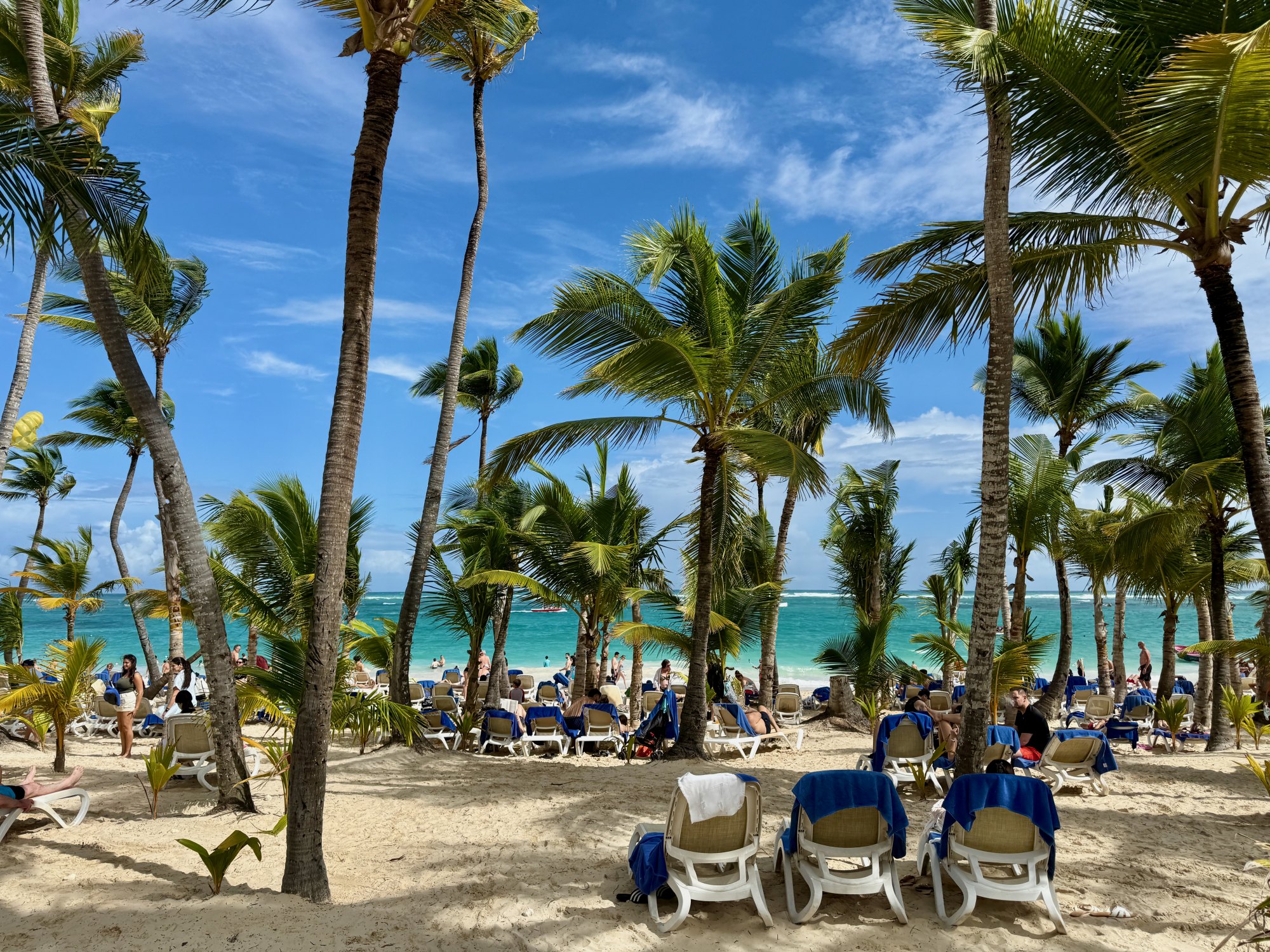
The sand is fine, pale and deep — the kind you sink into rather than walk on — and it shelves gently, so the water stays shallow a long way out. A reef line offshore takes the force out of the Atlantic swell, which is why the shallows are flat and glassy on most mornings. That reef is also why the colour reads the way it does: a pale band close in, a stronger turquoise past the sandbar, then a darker line where the coral sits. Morning is the calm part of the day. The trade wind usually builds through the afternoon, the water picks up a chop, and the kite and windsurf crowd go out on it.
Character changes as you walk. In front of the larger hotels the sand is raked, lined with matching loungers and palm shade, and busy from mid-morning. Between them are open stretches with nothing on them at all, and pockets where the beach turns commercial in the local sense: informal bars with plastic chairs, fishermen's boats pulled up, catamarans loading, vendors offering cigars, jewellery, massages and excursions. Being asked about a boat trip four times in a mile is part of the deal. A polite no, gracias ends it, and most owners end up finding the whole thing more likeable than the empty, supervised alternative.
Is Bávaro Beach public, and what does access actually mean?
The shoreline in the Dominican Republic is public. No hotel owns the sand in front of it, and there is no stretch of Bávaro you are barred from walking along. What a hotel does own is the frontage — the loungers, the umbrellas, the bar, the showers, and the guard who politely asks whether you are staying there. So the sand is open and the furniture is not, and the whole practical picture lives in that distinction.
In practice, access means having somewhere to arrive. Public entry points exist between the resorts, some with informal parking, and they are how most Dominican families reach the water at the weekend. For an owner living a few minutes inland, the more comfortable answer is a beach club: a fixed place to park, change, eat and sit, with no negotiating for a lounger. Ours is at Playa Bávaro and owner access is part of what buying here includes — which matters more for us than it would for a beachfront building, precisely because we are not the ones with sand at the door.
Seaweed and sargassum: the honest seasonal picture
Sargassum is real on this coast and we would rather write it down than dodge it. It is a floating brown seaweed that drifts in from the open Atlantic, and the east-facing beaches of the Dominican Republic — Bávaro among them — receive it. It is seasonal, broadly building through the spring and summer months and easing through autumn and winter, and it is genuinely variable: some years are heavy, some barely register, and nobody forecasts it reliably a season ahead. It is patchy along the shore, too. A windrow can pile up on one sector while the next one along, a mile away, is clear the same morning.
On the ground, the difference is who clears it. The larger hotels send crews out at dawn and some deploy offshore booms, so their frontage is usually presentable by breakfast; open public stretches depend on whoever turns up. When it lands, it lands as a brown band at the waterline that smells as it dries, and swimming through it is unpleasant rather than dangerous. Our answer for a guest who catches a bad week is simple and unglamorous: the pools. There are 16 of them behind the gate plus the river pool, and a week like that is exactly what earns them their place. Anyone promising you a sargassum-free beach is selling you something.
| Time of year | What the shore is usually like | What we plan around |
|---|---|---|
| December to April | Generally the clearest and calmest window, and the busiest for a reason. | Book early — this is when demand runs highest. |
| May to August | The likeliest window for sargassum landings, though it varies year to year and sector to sector. | Look at recent photos rather than brochures, and keep pool days in the plan. |
| September to November | Landings usually ease off; this is also the wetter, quieter end of the year. | Fewer people on the sand — watch the weather rather than the seaweed. |
What you can walk to, and what needs the car
Let us be plain about walkability, because it is where beach-adjacent listings tend to blur. From our gate, the beach is a drive and not a walk. What is walkable is what sits inside Atlántida: the pools, the tennis and pickleball courts, the spa and fitness rooms, the restaurants, and a 54,000 sq ft shopping centre. An ordinary errand run, on foot, without leaving the community. That is the daily-life half of the equation and for a lot of owners it is the half that gets used most.
The beach half runs on a short drive. Playa Bávaro is 5 minutes, and the strip behind it holds the dive shops, beach bars, bakeries, pharmacies and colmados that make up the everyday commerce of this coast — once you have parked, that strip walks end to end. Punta Cana International Airport is 10 minutes, close enough that a guest can land and be in the water the same afternoon. Guests without a car use taxis and the ride-hailing apps that operate in the area; owners who stay for a season almost always end up with one.
How Bávaro differs from the gated shores further east
East and south of here the coast changes character. The large gated developments have their own beaches behind a controlled entrance: fewer people, no vendors, very little noise, and access tied to being a resident or a guest. Bávaro is the opposite proposition. It is open, commercial and busy, with public entrances, hawkers, watersports and restaurants anyone can walk into. Neither is better in the abstract. They are different products, and choosing between them is really a decision about how much life you want happening around you.
For an owner who rents, that distinction is not academic. Guests who choose this coast usually choose the open version on purpose: they want to walk out of a beach bar onto a catamaran, eat somewhere that is not a resort buffet, and improvise a day. Sitting a few minutes back from it, behind a gate and with a beach club on the sand, tends to suit them well — the noise stays on the beach and the quiet stays at home. River Island is priced on that basis, from $199,000 for a furnished, rental-ready condo, with a developer projection of 12–15% annual returns. Those are the developer's figures and the assumptions behind them are a fair thing to ask for.
Common questions
- How far is River Island from Bávaro Beach?
- Playa Bávaro is a 5-minute drive from our gate, a little over a mile, so it is a short hop by car rather than a walk. Owners also have access to a beach club on the sand at Playa Bávaro, which gives you somewhere to park, change and sit rather than arriving at an open stretch with a towel.
- Can anyone use Bávaro Beach, or is the sand reserved for hotel guests?
- The sand itself is public along the whole coast and you can walk any part of it. What belongs to a hotel is its furniture and its service — the loungers, umbrellas, showers and bar in front of the building. Access is never really the question; having a comfortable base is, which is why a beach club or a known public entry point matters more here than the legal position does.
- When is sargassum worst at Bávaro, and how bad does it get?
- Landings are likeliest through late spring and summer and generally ease towards the end of the year, but the honest answer is that it varies a great deal between years and between one sector of the beach and the next. Some seasons barely register. Hotels clear their frontage at dawn; open public stretches depend on who turns up. For a summer trip we would keep the pools in the plan as a fallback rather than bet on either outcome.
- Is Bávaro Beach good for swimming?
- For most people, yes. The bottom shelves gently and the reef offshore keeps the swell down, so the water is shallow and usually flat, particularly in the morning. The trade wind builds through the afternoon and puts a chop on it, which is why the kite and windsurf crowd go out later in the day. Conditions do change, so read the flags and the local advice rather than the last photo you saw.
Want the details for your own situation?
Ask about availability, layouts or the buying process, and someone from the sales team will get back to you.
Get in touch